
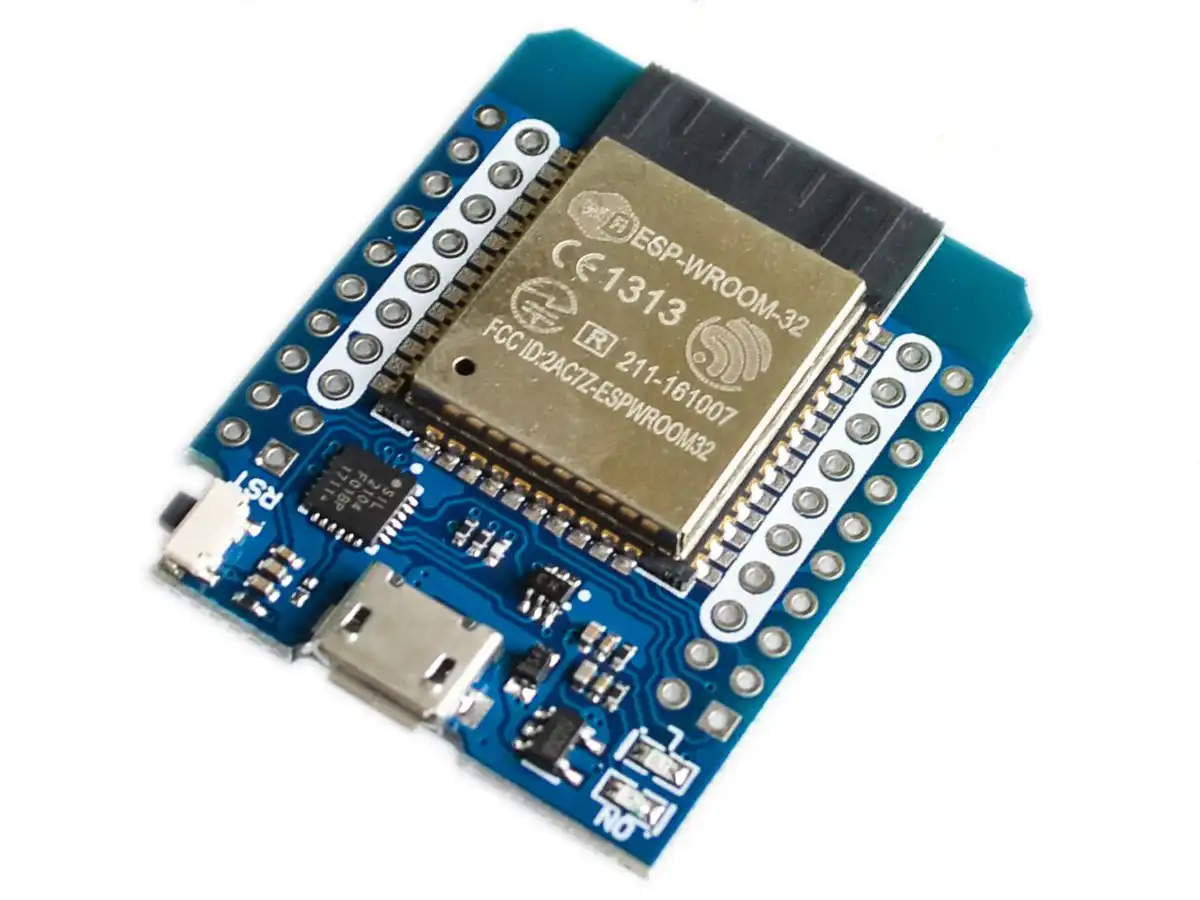


The D1 Mini ESP32 is a compact ESP32 development board that combines the popular D1 Mini form factor with the performance and wireless features of the Espressif ESP32 platform. It is based on the ESP32 microcontroller with dual-core Xtensa architecture, runs at up to 240 MHz, and includes 4MB flash memory. The board supports 2.4 GHz WiFi 802.11 b/g/n, Bluetooth 4.2, and BLE 4.2, making it an excellent choice for wireless control, sensor networks, smart home devices, automation, data logging, and compact IoT projects.
One of the biggest advantages of this D1 Mini ESP32 board is its familiar D1 Mini style layout. It fits the well-known shield ecosystem and gives you a much more powerful alternative to ESP8266-based mini boards. Despite its small size, it offers a rich set of interfaces including digital I/O, analog input, PWM, UART, I2C, SPI, DAC, and capacitive touch functions. The board exposes up to 34 digital I/O pins and up to 18 analog-capable inputs, giving developers plenty of flexibility for both simple and advanced applications.
The module includes a CH340C USB-to-UART interface with Micro-USB connection for programming and serial monitoring. Power can be supplied through USB or 5V/VIN, while the board also provides a regulated 3.3V rail for ESP32 operation. It features an onboard PCB antenna, a reset button, and a BOOT button connected to GPIO0 for flashing and recovery. Typical active current is around 80 mA, while deep sleep current can drop to below 10 µA in low-power applications.
For Arduino users, this D1 Mini ESP32 is especially attractive because it works very well with the Arduino IDE. In Arduino IDE 2, simply install the esp32 package by Espressif Systems through Boards Manager and select the board type D1 Mini32. Recommended settings for this board are CPU Frequency 240 MHz, Flash Size 4MB, Flash Mode DIO, and Upload Speed 921600. This makes the D1 Mini ESP32 a practical choice for the large number of users who prefer Arduino over ESP-IDF or other development environments.
The default communication pin functions are also convenient for Arduino development. Standard I2C uses SDA on GPIO21 and SCL on GPIO22. The primary SPI bus uses MOSI GPIO23, MISO GPIO19, SCK GPIO18, and CS GPIO5. The default USB serial programming interface is linked to UART0, while a second hardware UART is available on GPIO16 and GPIO17. Dual 8-bit DAC outputs are available on GPIO25 and GPIO26. Capacitive touch sensing is supported on GPIO0, GPIO2, GPIO4, GPIO12 to GPIO15, GPIO27, GPIO32, and GPIO33.
For analog use, ADC1 pins are the preferred choice, especially when WiFi is active. ADC1 channels on GPIO32 to GPIO39 remain usable during WiFi operation, while ADC2 pins share hardware resources with WiFi and may not be reliable for analog measurements when wireless functions are enabled. Input-only pins include GPIO34, GPIO35, GPIO36, and GPIO39, which are suitable for sensors and analog inputs but cannot be used as outputs.
When using the D1 Mini ESP32, special attention should be paid to ESP32 bootstrapping pins. GPIO0, GPIO2, and GPIO15 influence the boot process and should not be forced to the wrong level during reset. GPIO0 is used for boot mode selection, so it must normally remain HIGH for standard boot. GPIO2 and GPIO15 should also be used carefully in external circuits. In addition, pins tied to the onboard flash interface are not intended for normal user I/O.
Board dimensions are approximately 39 mm x 31 mm with 2.54 mm pin spacing, making the D1 Mini ESP32 breadboard-friendly and suitable for compact builds. This small size, combined with strong wireless capability and broad Arduino IDE support, makes it a very versatile module for makers, students, product developers, and repair or retrofit projects.
Typical applications for the D1 Mini ESP32 include WiFi sensor nodes, remote switches, MQTT devices, small display projects, environmental monitoring, web servers, serial gateways, automation controllers, and battery-powered embedded systems with deep sleep support. If you need more performance and more interfaces than an ESP8266 board can offer, but still want a compact and familiar mini-board format, the D1 Mini ESP32 is an excellent upgrade path.
Technical summary
Microcontroller: ESP32
Architecture: Dual-core Xtensa
Clock speed: up to 240 MHz
Flash memory: 4MB
Wireless: 2.4 GHz WiFi 802.11 b/g/n, Bluetooth 4.2, BLE 4.2
Digital I/O: up to 34
Analog inputs: up to 18
DAC outputs: GPIO25, GPIO26
Touch pins: GPIO0, GPIO2, GPIO4, GPIO12, GPIO13, GPIO14, GPIO15, GPIO27, GPIO32, GPIO33
USB interface: CH340C
Programming port: Micro-USB
Power input: 5V/VIN or USB
Logic voltage: 3.3V
Pin spacing: 2.54 mm
Board size: approx. 39 x 31 mm
Recommended Arduino IDE board setting: D1 Mini32

Reviews
There are no reviews yet.