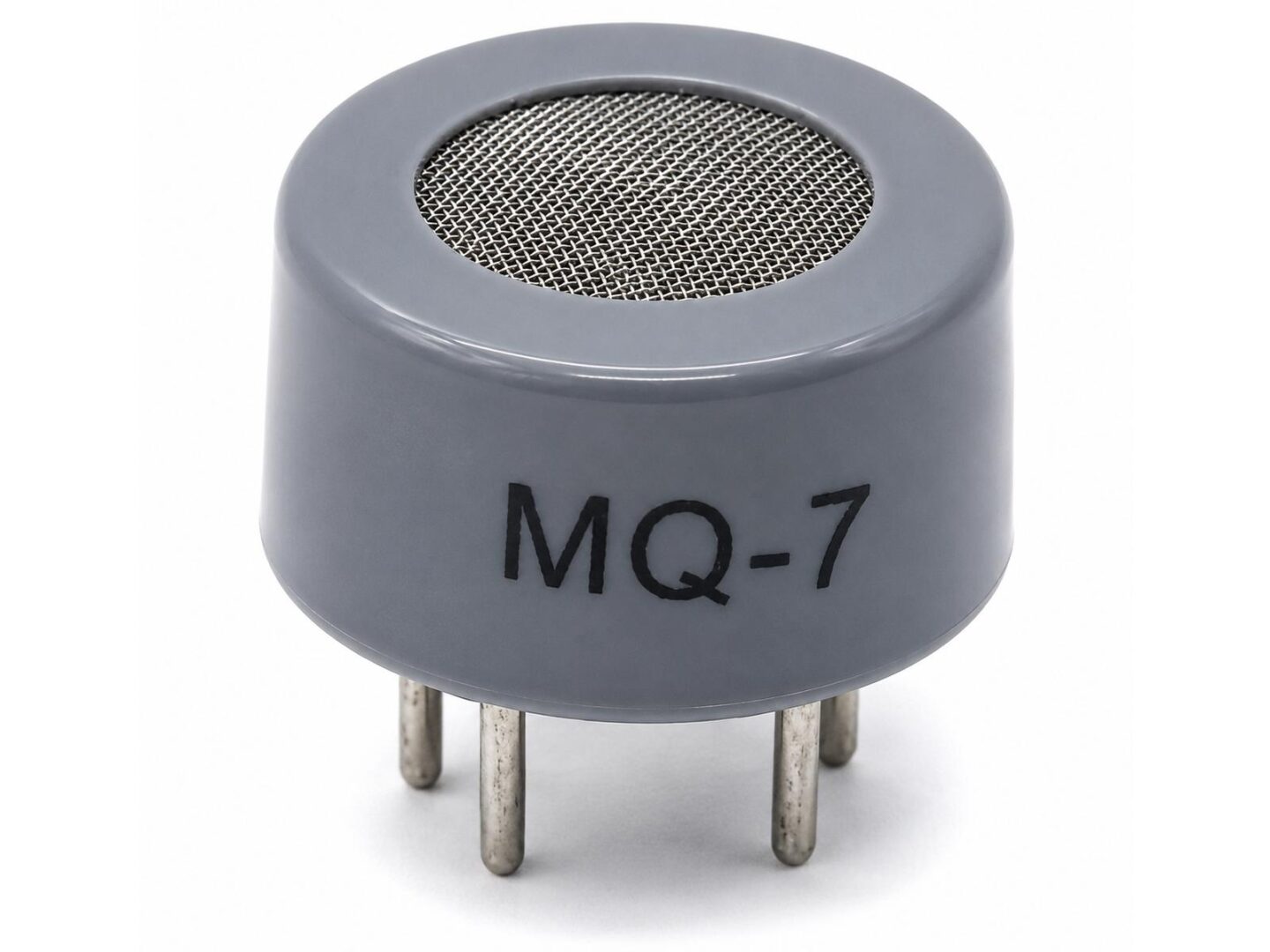
The MQ-7 Carbon Monoxide Sensor is a low-cost semiconductor gas sensor designed for detecting carbon monoxide (CO) in air. It is suitable for hobby electronics, Arduino projects, ESP32 projects, educational experiments, CO detector prototypes, and general gas-sensing demonstrations.
The sensor element uses tin dioxide (SnO2) as the gas-sensitive material. The sensor resistance changes when carbon monoxide is present, and this resistance change can be converted into a voltage signal using a simple external circuit with a load resistor.
Unlike many other MQ gas sensors, the MQ-7 Carbon Monoxide Sensor uses a cycling heater voltage. The heater is operated alternately at a high voltage and a low voltage. This heating cycle is important for proper carbon monoxide sensing and recovery, and should be considered when designing the circuit or writing microcontroller software.
About 10kΩ for calibration, adjustable range commonly 5kΩ-47kΩ
Operating temperature
-20°C to 50°C
Storage temperature
-20°C to 50°C
Relative humidity
Less than 95%RH
Recommended initial preheat time
No less than 48 hours for stable measurements
Typical service life
Up to 5 years under suitable operating conditions
Typical applications:
Arduino, ESP32, Raspberry Pi, and other microcontroller CO-sensing projects
Carbon monoxide detector prototypes
Educational gas sensor demonstrations
Automotive air-quality and exhaust-related experiments
DIY alarm and monitoring systems
Analog sensor experiments and comparator-based alarm circuits
Portable gas detector prototypes
Helpful information:
The MQ-7 Carbon Monoxide Sensor is not a digital sensor. The sensing element changes resistance depending on carbon monoxide concentration.
A load resistor is required to convert the sensor resistance change into a measurable voltage.
The MQ-7 requires a timed heater cycle: typically 60 seconds at 5V followed by 90 seconds at 1.4V.
For microcontroller projects, the heater cycle can be controlled with a transistor, MOSFET, or suitable driver circuit.
The analog output should normally be evaluated at the correct point in the heater cycle, not randomly during warm-up or recovery.
The sensor requires a long initial preheat period. Readings directly after power-up may drift and should not be treated as calibrated measurements.
Temperature, humidity, oxygen concentration, airflow, sensor age, and previous gas exposure can affect readings.
For accurate concentration readings, calibration with a known CO concentration is required.
Pin information
The MQ-7 sensing element has 6 pins. Four pins are used for the sensing signal connections, and two pins are used for the heater.
Heater connection
The heater must be driven with the required high and low voltage cycle.
Sensing connection
Use the sensing electrodes together with a load resistor to create an analog voltage output.
Important note
Incorrect wiring or applying the wrong voltage to the wrong pins can damage the sensor or prevent a valid output signal.
Basic operating principle:
The heater provides the required operating temperature for the sensing material.
The sensor is alternated between a high heater voltage phase and a low heater voltage phase.
The sensing resistance changes when carbon monoxide is present.
The external load resistor converts the resistance change into a voltage.
The output voltage can be connected to an analog input of a microcontroller or to a comparator circuit.
Recommended calibration approach:
Connect the sensor to the final application circuit.
Power the sensor and allow it to preheat for at least 48 hours before calibration.
Use a known carbon monoxide concentration if accurate readings are required.
The datasheet recommends calibration around 200ppm CO in air.
A load resistor around 10kΩ is commonly recommended, with adjustment possible depending on the circuit and target alarm point.
When setting an alarm threshold, consider the influence of temperature and humidity.
Recommended handling and operating precautions:
Avoid exposure to silicone vapours, silicone adhesives, silicone rubber, putty, or plastics containing silicone. Silicone contamination can permanently reduce sensor sensitivity.
Avoid highly corrosive gases such as H2S, SOx, Cl2, and HCl.
Avoid contamination from alkali materials, alkali metal salts, salt spray, halogens, or similar harsh chemicals.
Do not expose the sensor to water, condensation, freezing conditions, or direct liquid contact.
Do not apply voltages above the rated values.
Avoid long-term storage in polluted, humid, or high-temperature environments.
Avoid strong vibration, shock, or dropping the sensor.
Do not expose the sensor to very high gas concentrations for extended periods.
Construction details:
Sensing layer
SnO2
Electrode material
Gold
Electrode line
Platinum
Heater coil
Ni-Cr alloy
Ceramic tube
Al2O3
Protective mesh
Stainless steel gauze
Base material
Bakelite
Important safety note:
This sensor is intended for electronics projects, prototyping, education, and experimental carbon monoxide detection. It is not a ready-made certified carbon monoxide alarm, workplace safety device, automotive safety device, or life-safety instrument. Carbon monoxide is dangerous and can be deadly. For home, vehicle, workplace, or code-required CO protection, use properly certified carbon monoxide alarm equipment.
Reviews
There are no reviews yet.
Only logged in customers who have purchased this product may leave a review.
Related products
-50% -50%
C$9.90Original price was: C$9.90.C$4.99Current price is: C$4.99.

Reviews
There are no reviews yet.