
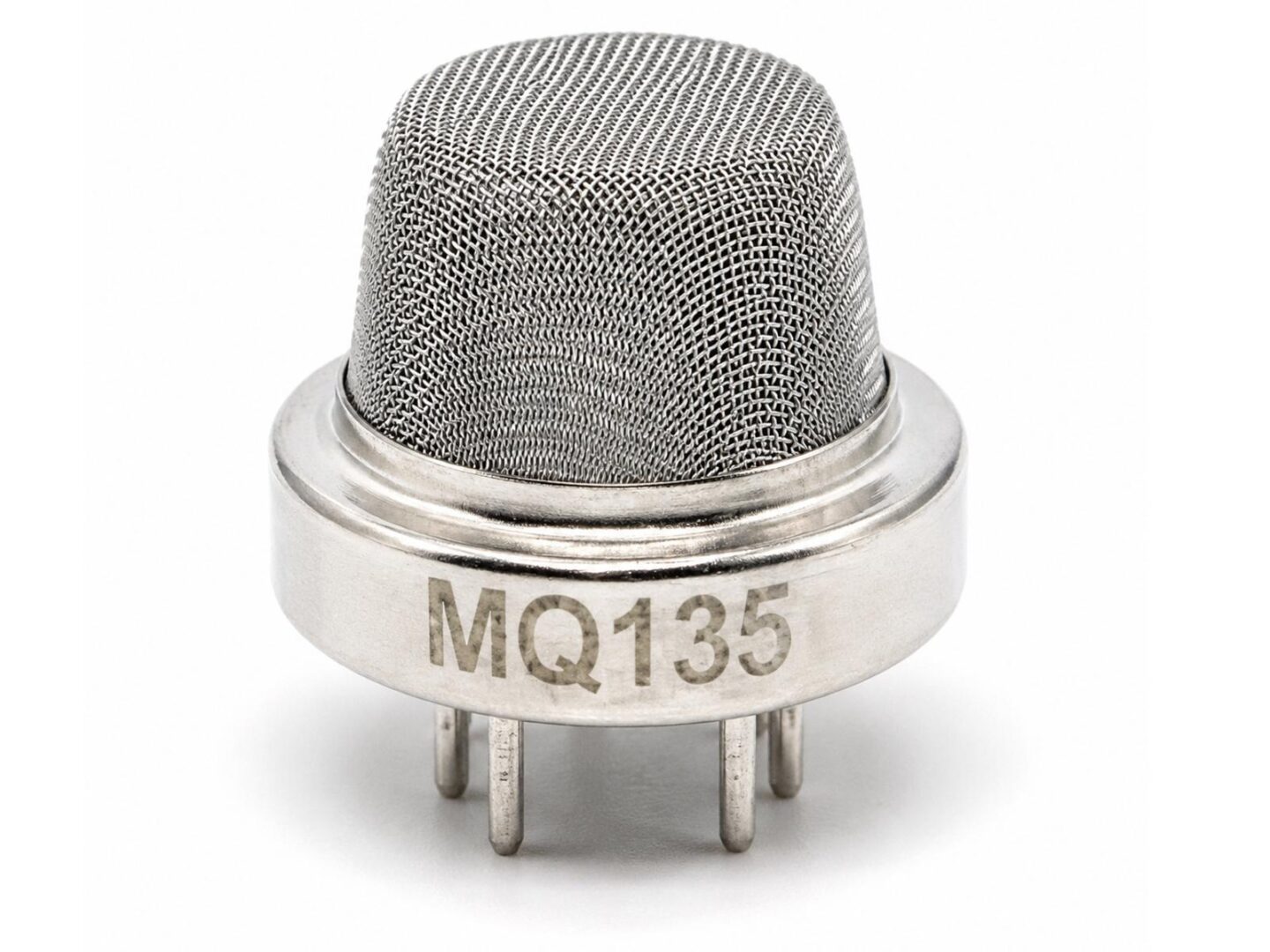
The MQ-135 Air Quality Sensor is a low-cost semiconductor gas sensor for general air-quality and pollution-gas detection. It is suitable for hobby electronics, Arduino projects, ESP32 projects, air-quality experiments, gas alarm prototypes, and educational sensor demonstrations.
The sensor element uses tin dioxide (SnO2) as the gas-sensitive material. In clean air, the material has relatively low conductivity. When pollution gases are present, the conductivity of the sensor increases as the gas concentration rises. With a simple external circuit, this change can be converted into an analog voltage signal that can be read by a microcontroller or comparator circuit.
The MQ-135 Air Quality Sensor is especially sensitive to ammonia gas, sulfides, and benzene-series vapours. It can also respond to smoke and other toxic gases, making it useful as a general-purpose air-quality sensor for experiments and monitoring projects.
Download MQ-135 Datasheet (PDF)
| Sensor type | Semiconductor gas sensor |
| Gas-sensitive material | Tin dioxide, SnO2 |
| Target gases | Ammonia gas, sulfide, benzene-series vapours |
| Also responds to | Smoke and other toxic gases |
| Typical detection range | 10-1000ppm for ammonia gas, toluene, hydrogen, and smoke |
| Standard encapsulation | Bakelite base with metal cap |
| Heater voltage | 5.0V ±0.1V AC or DC |
| Test circuit voltage | 5.0V ±0.1V DC typical, maximum circuit voltage 24V DC |
| Heater resistance | 29Ω ±3Ω at room temperature |
| Heater power consumption | Up to 950mW |
| Load resistor | Adjustable, commonly selected to suit the measuring circuit |
| Standard test conditions | 20°C ±2°C, 55% ±5%RH |
| Recommended initial preheat time | Over 48 hours for stable measurements |
Typical applications:
- Arduino, ESP32, Raspberry Pi, and other microcontroller air-quality projects
- Indoor air-quality experiments
- Gas alarm prototypes
- Smoke and pollution-gas detection experiments
- Educational gas sensor demonstrations
- Portable gas detector prototypes
- Analog sensor experiments and comparator-based alarm circuits
Helpful information:
- The MQ-135 is not a digital sensor. The sensing element changes resistance depending on the surrounding gas concentration.
- A load resistor is required to convert the sensor resistance change into a measurable voltage.
- The heater draws significant current. Make sure your 5V supply can provide enough power.
- The sensor requires warm-up time. Readings directly after power-up may drift and should not be treated as stable measurements.
- For more repeatable measurements, allow the sensor to stabilize before taking readings.
- Temperature, humidity, airflow, oxygen concentration, sensor age, and previous gas exposure can affect readings.
- The MQ-135 Air Quality Sensor responds to several gases, so it cannot reliably identify one specific gas by itself.
- For accurate concentration readings, calibration with a known reference gas or known test setup is required.
| Pin information | The MQ-135 sensing element has 6 pins. Pins 2 and 5 are used for the heater. Pins 1 and 3 are internally connected, and pins 4 and 6 are internally connected for the sensing electrodes. |
| Heater connection | Apply 5V ±0.1V to the heater pins. |
| Sensing connection | Use the sensing electrodes together with a load resistor to create an analog voltage output. |
| Important note | Do not apply the heater voltage to the sensing electrode pins. Incorrect wiring can damage the sensor. |
Basic operating principle:
- The heater brings the sensing material to its required operating temperature.
- The sensing resistance changes when pollution gases are present.
- The external load resistor converts this resistance change into a voltage.
- The voltage can be connected to an analog input of a microcontroller or to a comparator circuit.
Recommended handling and operating precautions:
- Avoid exposure to silicone vapours, silicone adhesives, silicone rubber, putty, or plastics containing silicone. Silicone contamination can permanently reduce sensor sensitivity.
- Avoid highly corrosive gases such as H2S, SOx, Cl2, and HCl.
- Avoid contamination from alkali materials, alkali metal salts, salt spray, halogens, or similar harsh chemicals.
- Do not expose the sensor to water, condensation, freezing conditions, or direct liquid contact.
- Do not apply voltages above the rated values.
- Avoid long-term storage in polluted, humid, or high-temperature environments.
- Avoid strong vibration, shock, or dropping the sensor.
- Do not test the sensor by directly spraying lighter gas or highly concentrated vapours onto it. Very high gas concentrations can damage or degrade the sensor.
Important safety note:
This sensor is intended for electronics projects, prototyping, education, and experimental air-quality or pollution-gas detection. It is not a ready-made certified gas alarm, workplace safety device, environmental compliance instrument, or life-safety detector. For safety-critical, legal, workplace, or certified air-quality applications, use properly certified equipment.
Reviews
There are no reviews yet.